
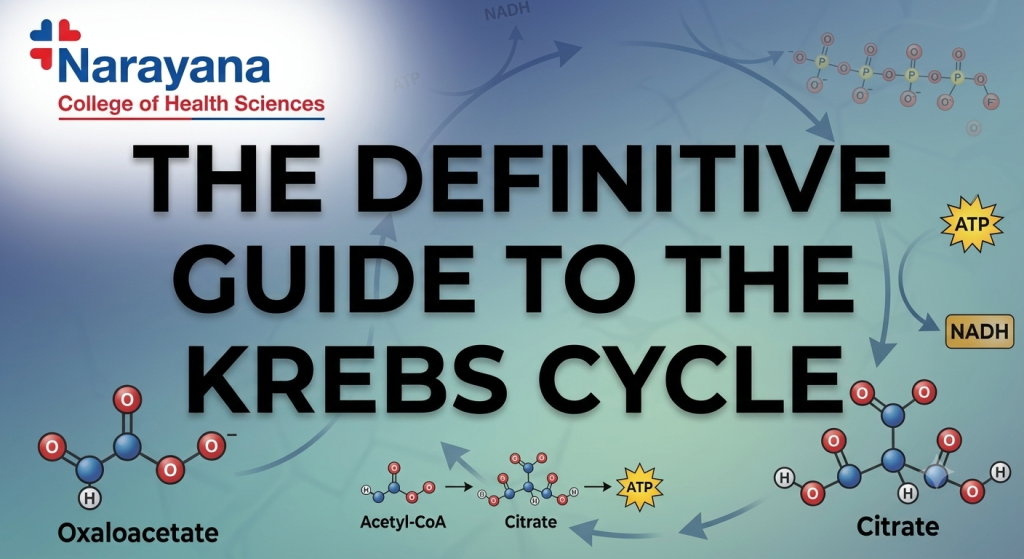
Quick answer: The Krebs cycle is an eight-step pathway in the mitochondrial matrix that fully oxidises acetyl-CoA to carbon dioxide. Each turn releases 2 CO₂ and captures energy as 3 NADH, 1 FADH₂ and 1 GTP, which works out to roughly 10 ATP per turn once the electron transport chain finishes the job.
The eight steps at a glance
| Reaction | Enzyme | Carbons | Energy captured |
| Acetyl-CoA + Oxaloacetate → Citrate | Citrate synthase | 2 + 4 → 6 | — |
| Citrate → Isocitrate | Aconitase | 6 → 6 | — |
| Isocitrate → α-Ketoglutarate + CO₂ | Isocitrate dehydrogenase | 6 → 5 | NADH |
| α-Ketoglutarate → Succinyl-CoA + CO₂ | α-KG dehydrogenase complex | 5 → 4 | NADH |
| Succinyl-CoA → Succinate | Succinyl-CoA synthetase | 4 → 4 | GTP |
| Succinate → Fumarate | Succinate dehydrogenase | 4 → 4 | FADH₂ |
| Fumarate → Malate | Fumarase | 4 → 4 | — |
| Malate → Oxaloacetate | Malate dehydrogenase | 4 → 4 | NADH |
Per turn: 3 NADH + 1 FADH₂ + 1 GTP + 2 CO₂
In June 1937, the journal Nature rejected a submitted paper. The editors said they had a backlog. The author, a German-born biochemist working at Sheffield after fleeing the Nazi regime, sent it to a smaller Dutch journal called Enzymologia instead, where it appeared two months later.
That paper described the citric acid cycle. Sixteen years later it won Hans Krebs the Nobel Prize, and today it sits in the second-semester syllabus of essentially every medical, nursing and allied health programme on the planet.
It also has a reputation. Ask any student which pathway they dread and the Krebs cycle comes up more than anything else, usually because it gets taught as eight names to memorise in order. That’s the wrong way to hold it. The cycle only makes sense once you see what it’s actually doing, which is stripping electrons off a two-carbon fragment and handing them to a machine that turns them into ATP.
Everything else is bookkeeping.
What is the Krebs cycle?
The Krebs cycle is a closed loop of eight enzymatic reactions that completely oxidises the acetyl group of acetyl-CoA into two molecules of carbon dioxide, capturing the released energy in reduced coenzymes.
It goes by three names, all correct:
- Krebs cycle — after Hans Krebs
- Citric acid cycle — after the first product formed
- TCA (tricarboxylic acid) cycle — because citrate, cis-aconitate and isocitrate each carry three carboxyl groups
The word cycle is doing real work here. Oxaloacetate is consumed in step 1 and regenerated in step 8, so the pathway never runs out of its own starting material. One oxaloacetate molecule can theoretically process an unlimited number of acetyl groups, which is why the cycle needs only catalytic quantities of its intermediates rather than stoichiometric ones.
Here’s the part that catches people out: the two carbons that leave as CO₂ during the first turn are not the two carbons that just entered as acetyl-CoA. Isotope labelling settled this decades ago. The carbons released in turn one come from the oxaloacetate half of the molecule. The acetyl carbons stay in the loop and exit on later turns.
Where does the Krebs cycle take place?
The Krebs cycle occurs in the mitochondrial matrix in eukaryotic cells. All eight enzymes are soluble matrix proteins with one exception.
Succinate dehydrogenase is bound to the inner mitochondrial membrane, because it isn’t only a Krebs cycle enzyme. It’s also Complex II of the electron transport chain. This is the only enzyme shared between the two pathways, and it’s the reason FADH₂ from step 6 delivers its electrons directly into the ubiquinone pool rather than travelling anywhere.
In prokaryotes, which have no mitochondria, the whole cycle runs in the cytoplasm.
What happens before the cycle?
The Krebs cycle cannot accept pyruvate. Glycolysis ends with pyruvate in the cytosol, so something has to bridge the gap, and that bridge is the link reaction, also called oxidative decarboxylation or the transition step.
Pyruvate (3C) + CoA-SH + NAD⁺ → Acetyl-CoA (2C) + CO₂ + NADH + H⁺
The enzyme responsible is the pyruvate dehydrogenase (PDH) complex, a large multi-enzyme assembly of three catalytic components requiring five coenzymes: thiamine pyrophosphate, lipoic acid, coenzyme A, FAD and NAD⁺.
Note the vitamin dependency, because it matters clinically. Thiamine pyrophosphate comes from vitamin B1. Take thiamine away and PDH stalls, pyruvate backs up, and the cell shunts it to lactate instead. That single mechanism sits underneath beriberi and Wernicke’s encephalopathy.
Strictly speaking the link reaction is not part of the Krebs cycle. Examiners test that distinction, and students lose marks on it constantly.
The eight steps of the Krebs cycle
Step 1 — Citrate synthase: the condensation
Acetyl-CoA (2C) + Oxaloacetate (4C) + H₂O → Citrate (6C) + CoA-SH
The two-carbon acetyl group condenses with four-carbon oxaloacetate to make six-carbon citrate. The energy for this comes from hydrolyzing the high-energy thioester bond in acetyl-CoA, which makes the reaction strongly exergonic and effectively irreversible.
Citrate synthase is inhibited by ATP, NADH, succinyl-CoA and citrate itself. The cell doesn’t start a process it can’t afford.
Step 2 — Aconitase: the reshuffle
Citrate → cis-Aconitate → Isocitrate
No carbon lost, no energy captured, nothing obviously accomplished. So why does it happen?
Because citrate has a tertiary hydroxyl group, and tertiary alcohols cannot be oxidised. Aconitase removes water and adds it back at a different position, converting citrate into isocitrate, which carries a secondary hydroxyl. Now the molecule can be oxidised. Step 2 exists purely to set up step 3.
Aconitase is the target of fluoroacetate, a rodenticide sold as compound 1080. It’s converted in the cell to fluorocitrate, which jams aconitase and shuts down the entire cycle. This is called lethal synthesis: the poison is harmless until your own metabolism activates it.
Step 3 — Isocitrate dehydrogenase: the rate-limiting step
Isocitrate + NAD⁺ → α-Ketoglutarate (5C) + CO₂ + NADH
The first oxidative decarboxylation. Six carbons become five, the first CO₂ is released, and the first NADH is produced.
This is the rate-limiting step of the Krebs cycle, and if you remember one regulatory fact from this article, make it that one. Isocitrate dehydrogenase is allosterically activated by ADP and Ca²⁺, and inhibited by ATP and NADH. High ADP means the cell is spending energy, so the cycle accelerates. High ATP means it isn’t, so the cycle slows.
Step 4 — α-Ketoglutarate dehydrogenase: the second decarboxylation
α-Ketoglutarate (5C) + NAD⁺ + CoA-SH → Succinyl-CoA (4C) + CO₂ + NADH
Five carbons become four, the second CO₂ leaves, and a second NADH is made. Both of the cycle’s carbon dioxides have now been released.
Look closely at this enzyme and you’ll notice it’s built almost exactly like the PDH complex from the link reaction: three components, the same five coenzymes, the same irreversible oxidative decarboxylation chemistry. Evolution wrote the mechanism once and reused it.
Practical consequence: thiamine deficiency knocks out both enzymes simultaneously. In neurological thiamine deficiency, α-ketoglutarate dehydrogenase is often the more sensitive of the two.
Step 5 — Succinyl-CoA synthetase: the only direct payoff
Succinyl-CoA + GDP + Pi → Succinate + GTP + CoA-SH
The thioester bond in succinyl-CoA is energy-rich, and rather than waste it, the cell uses it to phosphorylate GDP directly. This is the cycle’s only substrate-level phosphorylation, meaning the only step that produces a nucleotide triphosphate without involving the electron transport chain.
In animal tissues the product is GTP, which nucleoside diphosphate kinase converts to ATP one-for-one. Plants and bacteria have an isoform that makes ATP directly. Either way, count it as one ATP.
The enzyme’s name is backwards, incidentally. It’s called a synthetase because it was named for the reverse direction, where succinyl-CoA is synthesised.
Step 6 — Succinate dehydrogenase: the membrane enzyme
Succinate + FAD → Fumarate + FADH₂
The only step producing FADH₂ rather than NADH, and the only enzyme physically embedded in the inner mitochondrial membrane. As Complex II of the electron transport chain, it hands electrons straight into ubiquinone without a free FADH₂ molecule ever floating away.
This step also has historical weight. Malonate competitively inhibits succinate dehydrogenase because it looks structurally similar to succinate, and Krebs used precisely that inhibition to work out the sequence of the pathway. Block one step, watch which intermediate piles up, deduce the order.
Step 7 — Fumarase: adding water
Fumarate + H₂O → L-Malate
A stereospecific hydration. Fumarase adds water across the double bond in the trans configuration and produces only the L-isomer of malate, never the D-isomer. Enzymes don’t make racemic mixtures.
Step 8 — Malate dehydrogenase: closing the loop
Malate + NAD⁺ → Oxaloacetate + NADH
The third and final NADH, and oxaloacetate is back, ready to accept the next acetyl-CoA.
There’s something quietly interesting here. This reaction is thermodynamically unfavourable in isolation, with a positive standard free energy change. It runs anyway, because citrate synthase consumes oxaloacetate the instant it appears and keeps the product concentration near zero. The cycle pulls itself forward.
Mnemonic for the sequence: Citrate Is Krebs’ Starting Substrate For Making Oxaloacetate — Citrate, Isocitrate, α-Ketoglutarate, Succinyl-CoA, Succinate, Fumarate, Malate, Oxaloacetate.
How much ATP does the Krebs cycle produce?
This is the question that generates the most confusion online, and the confusion is real rather than imagined. Different textbooks give different answers because the field revised its numbers.
The older convention: 1 NADH = 3 ATP, 1 FADH₂ = 2 ATP. The current convention: 1 NADH = 2.5 ATP, 1 FADH₂ = 1.5 ATP.
The revision came from actually measuring proton stoichiometry. NADH oxidation pumps about 10 protons across the inner membrane, FADH₂ about 6, and the ATP synthase needs roughly 4 protons per ATP once you include the cost of transporting phosphate and ADP. The arithmetic gives fractions. Biology was never obliged to produce whole numbers.
Per turn of the cycle
| Product | Quantity | Modern yield | Classical yield |
| NADH | 3 | 7.5 ATP | 9 ATP |
| FADH₂ | 1 | 1.5 ATP | 2 ATP |
| GTP | 1 | 1 ATP | 1 ATP |
| Total | 10 ATP | 12 ATP |
Per glucose molecule
One glucose yields two pyruvate, so the cycle turns twice. That’s 20 ATP by modern values, 24 ATP by classical ones.
Complete oxidation of one glucose
| Stage | Yield | Modern | Classical |
| Glycolysis | 2 ATP + 2 NADH | 7 | 8 |
| Link reaction (×2) | 2 NADH | 5 | 6 |
| Krebs cycle (×2 turns) | 6 NADH + 2 FADH₂ + 2 GTP | 20 | 24 |
| Total | 32 ATP | 38 ATP |
Those totals assume the malate-aspartate shuttle carries cytosolic NADH into the mitochondrion. Tissues using the glycerol-3-phosphate shuttle instead convert that NADH to FADH₂, losing 1 ATP each, which gives 30 modern or 36 classical.
Which number should you write in an exam? Whichever one your syllabus uses. NCERT, NEET and most Indian university curricula still teach 3 and 2, giving 12 ATP per turn and 38 per glucose. Write that, and understand why the modern figure differs. Knowing both is the difference between memorising and comprehending, and viva examiners can tell.
How is the Krebs cycle regulated?
Three enzymes carry the regulatory load, and all three catalyse irreversible reactions. That’s not a coincidence: cells put control points where reactions can’t run backwards.
| Enzyme | Activated by | Inhibited by |
| Citrate synthase | ADP | ATP, NADH, succinyl-CoA, citrate |
| Isocitrate dehydrogenase (rate-limiting) | ADP, Ca²⁺ | ATP, NADH |
| α-Ketoglutarate dehydrogenase | Ca²⁺ | NADH, succinyl-CoA, ATP |
Two patterns run through the whole table.
Energy charge. ATP and NADH are the products, and they inhibit. ADP is the signal of energy demand, and it activates. The cycle is a demand-driven system, not a constantly running one.
Calcium. Ca²⁺ is the ion released when a muscle cell is told to contract. The same ion that triggers contraction also switches on the pathway that pays for it, which means energy production ramps up at the same moment the demand arrives rather than lagging behind it. That’s elegant design, and it’s worth pausing on.
There’s also an oxygen dependency that isn’t obvious from the reactions themselves. No step in the Krebs cycle uses oxygen directly. But NADH and FADH₂ must be reoxidised by the electron transport chain, which does need oxygen, and without regenerated NAD⁺ the cycle stops within seconds. This is why the Krebs cycle is classified as aerobic despite containing no oxygen-consuming step.
From the pathway to the patient
Metabolic biochemistry has a presentation problem. On a whiteboard it looks like an abstraction, a wheel of names with arrows between them, invented to be examined.
In a hospital it looks like a lactate reading climbing on a monitor. It looks like an alcohol-dependent patient who gets intravenous thiamine before glucose, in that order, because giving it the other way round can precipitate Wernicke’s encephalopathy. It looks like a nutritional assessment that catches a deficiency before the neurology shows up.
Those aren’t case studies. They’re Tuesday.
At Narayana College of Health Sciences, students in allied health sciences, nursing and physiotherapy study within the Narayana Health campus at Bommasandra, Bengaluru, where the pathway you learned on Monday shows up in a chart on Wednesday. Biochemistry stops being memorisation somewhere around the point you meet the patient it explains.

