
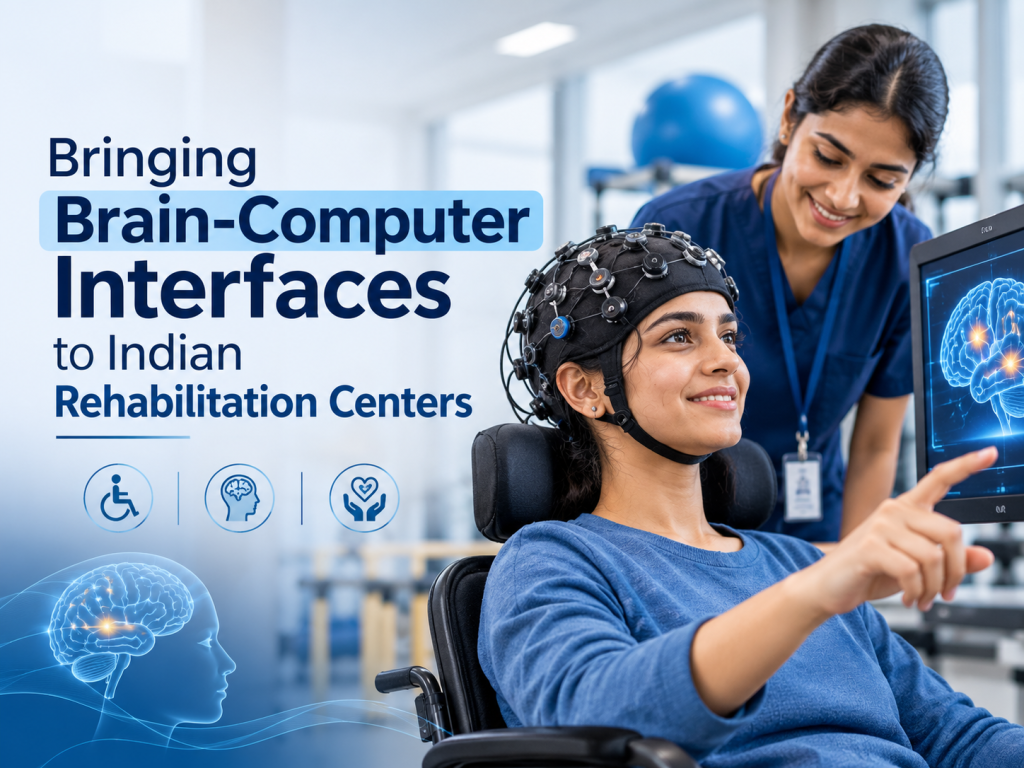
Imagine a stroke survivor who can no longer move their hand, but by simply imagining the movement, a robotic device helps their fingers grasp again. This is the promise of motor imagery brain-computer interfaces (MI-BCIs) technology that reads electrical brain signals through EEG sensors and translates imagined movements into real actions via assistive devices like robotic orthoses or functional electrical stimulation systems. While the science behind this is compelling, moving it out of research labs and into everyday Indian hospitals is proving far more complicated than perfecting the algorithms themselves.
This is the subject of our narrative review, “From Lab to Clinic: A Narrative Review of Motor Imagery Brain-Computer Interfaces for Neurorehabilitation in India,” recently published in the Tamil Nadu Journal of Health Research and Innovation (Volume 1, Issue 1). The review draws on 15 key studies published between 2012 and 2026, searched across PubMed, Scopus, Google Scholar, and India-specific sources like the Clinical Trials Registry – India (CTRI) and the Shodhganga thesis repository.
Why the Lab Doesn’t Match the Clinic?
Most BCI research happens in tightly controlled lab settings with ideal conditions and highly motivated participants. Real hospitals look nothing like that. Patients vary widely in age, education, and health status; equipment must survive constant use; and therapists are often stretched thin across dozens of patients a day. As a result, decoding accuracies that look impressive on paper (often around 80% offline) frequently decline once systems face live, real-time use sometimes dropping to near 70%. That drop isn’t a fixed universal number; it depends heavily on the population, task design, signal stability, and hardware involved. Whether 70% is even “good enough” depends on the task functional for simple wheelchair control, but insufficient for more complex multi-class commands.
There’s also a shift happening in how the field talks about people who struggle to use these systems. The older term “BCI illiteracy” wrongly implied something was wrong with the user. The review instead advocates for terms like “BCI non-responders,” recognizing that poor performance usually reflects gaps in training protocols, unclear instructions, electrode placement, or inflexible algorithms not a personal deficiency. These reframing matters because it puts the responsibility on designing better systems, not blaming patients.
Hardware Trade-offs for Indian Hospitals
One practical decision clinics face is choosing between traditional wet EEG electrodes and newer dry, portable sensors. Wet systems offer stronger signal quality and motion stability but require lengthy setup (20–40 minutes), gel application, and thorough cleaning impractical in high-volume public hospitals. Dry electrodes cut setup time to just a few minutes and are more portable but can be more sensitive to movement artifacts and environmental noise. Neither option is universally superior; the right choice depends on the clinical setting and patient volume.
The Human Side of the Technology
Sustained motor imagery is mentally exhausting. Patients can experience frustration and fatigue, especially when unstable signals cause the system to misread their intent. Because of this, evaluating a BCI system purely on classification accuracy misses the bigger picture. The review calls for broader measures information transfer rate, task completion and false-activation rates, calibration time, and standardized tools like the System Usability Scale and NASA-TLX to capture whether a device actually works for real people in real settings. Importantly, decoding accuracy and genuine neuroplastic recovery aren’t the same thing; a patient can show strong rehabilitation gains even with moderate classifier performance.
Unique Indian Challenges
India’s healthcare landscape adds layers of complexity rarely discussed in international BCI research. There’s a steep divide between well-resourced private hospitals and overburdened public tertiary centers institutions like NIMHANS and AIIMS have led early pilot studies, but scaling beyond them is limited by high patient-to-therapist ratios that leave no room for lab-style setups requiring lengthy preparation.
Language adds another barrier. Most motor imagery instructions are designed in English, using abstract phrasing like imagining a “kinesthetic first-person sensation” of grasping concepts that translate poorly across India’s many regional languages and may not resonate with patients from varied educational backgrounds. The review proposes this as a testable research question: could localized, culturally familiar metaphors improve how well patients engage with the system?
Patient data privacy is equally critical, since EEG recordings are deeply personal biometric information. As cloud-based processing becomes more common globally, Indian clinics need clear informed consent, secure local data storage, and encrypted transmission to protect patients while adopting these tools responsibly.
A Four-Stage Path Forward
The review proposes a four-stage translational framework: (1) personalized calibration using active engagement and validated imagery-vividness assessments; (2) adaptive online classifiers that continuously adjust to shifting brain signals in real time; (3) two-way “co-adaptation,” where the system monitors fatigue through brainwave ratios and adjusts difficulty or triggers rest breaks; and (4) long-term tracking of actual functional recovery using clinical scales like the Fugl-Meyer Assessment rather than just decoding accuracy. A complementary Markov chain-based method models user performance as a sequence of shifting mental states, helping therapists pinpoint exactly where a patient’s control breaks down.
Looking Ahead
Ultimately, the success of brain-computer interfaces in neurorehabilitation won’t be measured by how precisely a lab can decode brain signals, but by how well the technology adapts to real patients, real language, and real healthcare systems. With its expanding research institutions and strong technical talent, India is well positioned to help shape scalable, culturally attuned models for this next generation of neurotechnology.


