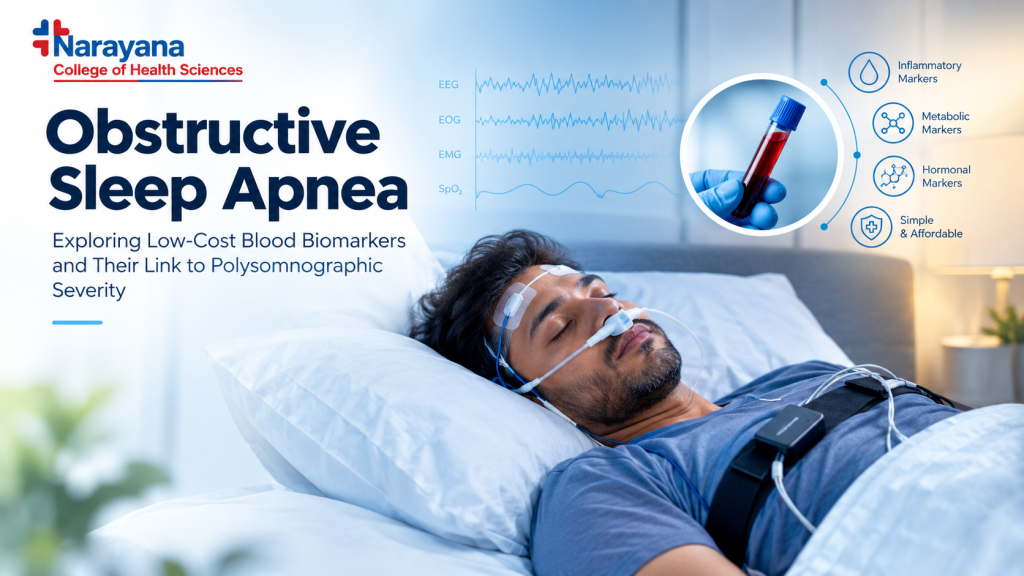
Obstructive sleep apnea (OSA) affects an estimated one billion adults worldwide, about 425 million of them with moderate-to-severe disease. Reported prevalence in India ranges from 3.7% to 21%. Severity is classified by the apnea-hypopnea index (AHI), which correlates poorly with comorbidity risk and symptom burden. This review examines the rationale for five routinely available biomarkers (serum uric acid, fibrinogen, neutrophil-to-lymphocyte ratio [NLR], platelet-to-lymphocyte ratio [PLR], and systemic inflammatory response index [SIRI]) as adjuncts to polysomnography (PSG), and identifies the gaps that limit their clinical adoption.
Introduction
OSA involves recurrent upper airway obstruction during sleep, producing intermittent hypoxia and sleep fragmentation. These drive oxidative stress, sympathetic activation, endothelial dysfunction, and systemic inflammation. The resulting morbidity includes hypertension, type 2 diabetes, coronary artery disease, heart failure, and stroke. Despite this burden, OSA remains underdiagnosed and undertreated.
Limitations of the AHI
The AHI is a frequency-based count that treats all respiratory events as equivalent, regardless of duration, desaturation depth, arousal burden, or cumulative intermittent hypoxia. A patient with moderate AHI but severe nocturnal hypoxemia and high inflammatory load may therefore carry greater cardiometabolic risk than one with a higher AHI and preserved oxygenation. Current AASM and ICSD criteria, and the AHA and ERS guidelines, do not incorporate biomarker-based or REM-specific stratification.
Candidate Biomarkers
Cytokines such as IL-6 and TNF-α are well characterized in OSA, but their dependence on advanced immunoassays limits use in resource-constrained systems. Two mechanistic categories of low-cost markers are proposed:
• Oxidative stress and coagulation: Serum uric acid, produced via hypoxia-induced xanthine oxidase activity, has been correlated with AHI and independently associated with hypertension and metabolic syndrome. Fibrinogen, an acute-phase reactant, is elevated in OSA and reflects pro-thrombotic tendency and stroke risk.
• Systemic immune-inflammation: NLR and PLR, derived from the complete blood count, are elevated in OSA and linked to severity and adverse cardiovascular outcomes. SIRI additionally incorporates monocytes and has shown stronger predictive value for severe OSA than NLR in recent retrospective analyses.
Research Gaps
Seven gaps were identified:
1. Evidence: Affordable markers are underexplored relative to cytokines and CRP.
2. Conceptual: Links between sleep-stage disturbances (e.g., REM-predominant disease) and biomarker signatures are poorly defined.
3. Methodological: Studies are typically cross-sectional, single-center, underpowered, and inadequately controlled for confounders.
4. Measurement: AHI dominates, while REM-AHI, hypoxic burden, and arousal index are overlooked.
5. Population: Cohorts are largely Western and male; Indian populations are underrepresented.
6. Temporal: Longitudinal data on prognosis and CPAP response are lacking.
7. Translational: No validated pathway integrates biomarker testing with PSG triage.
Conclusion
Uric acid, fibrinogen, NLR, PLR, and SIRI are biologically plausible and pragmatically feasible complements to PSG-based classification. This review is conceptual, and the clinical utility of these markers remains unvalidated. Adequately powered, longitudinal, stage-specific studies in diverse populations are needed before decision-support pathways can be established, particularly in low- and middle-income settings.